Showing posts with label Meat and game. Show all posts

Tuesday, October 23, 2012

Lamb T-Bones and Eggplant

Recipe: Lamb T-Bones and Eggplant
Page: 185
Date Cooked: October 22, 2012

This recipe follows a pretty common pairing - lamb and eggplant. And if it's not broke, why fix it? Furthermore, the recipe includes additional typical ingredients paired with lamb - eggplant and red wine. I may be getting to the punchline early, but the recipe is simple and ingredients really get a chance to sing.

Ingredients: Onion, garlic, Zinfandel, olive oil, lamb T-bones, parsley, rosemary, eggplant, Kosher salt, and black pepper

I sliced the onion and smashed the garlic. I put Zinfandel, olive oil, and garlic in a large bowl and mixed it together. I added the lamb t-bones to the bowl and turned to coat with the marinade. I sprinkled the onion, a few sprigs of parsley and rosemary to the bowl. I let the lamb marinate for 3 hours in the fridge, turning the lamb twice.

Marinating the lamb

I prepped the grill. I cut the eggplant in half, coated it with olive oil, and sprinkled with salt and pepper.

Prepping the eggplant

I grilled the eggplant halves, cut side down for a few minutes. While the eggplant remained on the grill, I patted the lamb t-bones dry and seasoned them with salt and pepper. I then turned the eggplant over on the grill and added the lamb t-bones. After a few minutes, I turned the t-bones over. The t-bones cooked until medium-rare.

Eggplant and lamb t-bones on the grill

I removed the eggplant and lamb t-bones off the grill. I let the lamb rest for a few minutes and then plated. I placed an eggplant half and two lamb t-bones (they were small) on a plate.

Lamb T-Bones and Eggplant

Simple. Simple. Simple. The seasoning was really just salt and pepper, and it worked. The eggplant was great and I loved the beautiful grill marks. The lamb t-bones were cooked to perfection - perfectly medium-rare, tender, and juicy. Like I said at the start of this post, this recipe was really about the pureness of the ingredients. I enjoyed it thoroughly!

Enjoy!

P.S. I cannot believe it, this is my 100th recipe!!! Only 15 more to go!!!

Tuesday, October 9, 2012

Grilled Rabbit with Roasted Tomato Salsa

Recipe: Grilled Rabbit with Roasted Tomato Salsa
Page: 194
Date Cooked: September 28, 2012

I'm not sure how popular rabbit cooking is for the home cook or perhaps it's a regional thing. However, it is safe to say I hadn't cooked rabbit prior to this recipe. I had to special order the rabbit from my grocer (I later found out that the Amish families at the farmers market sometimes have it), waited a week for it to arrive, and was quite excited for this recipe.

Shallots, garlic, rose wine, olive oil, rosemary sprigs, rabbit, plum tomatoes, Kosher salt, black pepper, and unsalted butter

The recipe called for the rabbit to marinate for 12-48 hours. Accordingly, upon getting the rabbit (already cut into pieces by my butcher) I went right to marinating. I sliced some shallots and peeled half a garlic head's worth of cloves. I combined the wine, the shallots, garlic, olive oil, and rosemary in a large bowl. I added the rabbit pieces, covered with plastic, and let it marinate in the fridge.

Rabbit in the marinade

Two days later, I resumed the recipe. I cut the tomatoes in half, sprinkled them with salt and pepper, topped them with the rest of the garlic, some more shallots, minced rosemary, and olive oil. I placed the pan of tomatoes in the oven to roast. Upon removing the tomatoes from the oven, I transferred the contents to a bowl, and crushed the tomatoes with a wooden spoon.

Roasted Tomato Salsa

Then it was time to grill the rabbit. I removed the rabbit from the marinade, rubbed the rabbit pieces with olive oil, and seasoned it with salt and pepper. I placed the rabbit on the grill and let it cook for about 20 minutes - 10 minutes on each side.

Grilling the rabbit

In the meantime, I heated some olive oil in a pan, added the garlic and shallots from the marinade, and sauteed until they became brown. I then poured in the reserved marinade, additional wine, and let the it boil. I strained the wine mixture into another saucepan and reduced it to about a cup. I finished the wine reduction with some butter.

Making the wine sauce

Then it was time to plate. Jonathan Waxman suggests serving the rabbit with buttered fettuccine. I happened to have made fettuccine earlier that week and this was a perfect use of it. I placed some fettuccine on a plate, added the rabbit, spooned the wine sauce over the rabbit, and garnished it with the tomato salsa.

Grilled Rabbit with Roasted Tomato Salsa

This was such a fun recipe to make; and when you look at it, it didn't take too much work. The most time intensive part was the marinating and heck you don't have to do anything while it marinates. But the flavors are so complex. I loved the gaminess of the rabbit and it definitely had that wonderful grill flavor. The wine sauce was delicious and it added a bit of sweetness and fat to the dish. The roasted tomato salsa was incredibly flavorful, I could have just eaten the salsa on its own. As a result of each component being great, the dish as a whole was soo freaking good. It was without a doubt restaurant quality material!

Enjoy!

Wednesday, March 28, 2012

Pork Tenderloin with Portobello Mushroom Sauce

Recipe: Pork Tenderloin with Portobello Mushroom Sauce
Page: 178
Date Cooked: February 19, 2012

Jonathan Waxman has three pork based recipes in A Great American Cook: (1) Pork Shoulder with Mole Sauce; (2) Brined Pork with Huckleberries or Blueberries; and (3) this one - Pork Tenderloin with Portobello Mushroom Sauce. I recall the previous two recipes being quite good so I had high hopes for this last pork dish.

Ingredients: Pork tenderloin, onion, garlic, parsley, Merlot, new potatoes, parsnips, turnips, rutabaga, fennel bulbs, portobello mushrooms, shallots, olive oil, butter, salt, pepper, and chicken broth

The first step involved getting the pork marinated. I sliced the onion and smashed garlic. I combined the onion, garlic, parsley stems, and Merlot into a bowl and stirred together. I added the pork, turning it in the marinade. I covered the bowl and let the pork marinate for a few hours.

Pork tenderloin in marinade

Then it was on to the root veggies. I peeled the potatoes, parsnips, turnips, and rutabaga and cut them all into bite-sized pieces. All the root vegetables were then placed in a bowl of cold water. Additionally, I trimmed the fennel, cut it in half, and removed the core.

Bite-sized pieces of potatoes, parsnips, turnips, and rutabaga

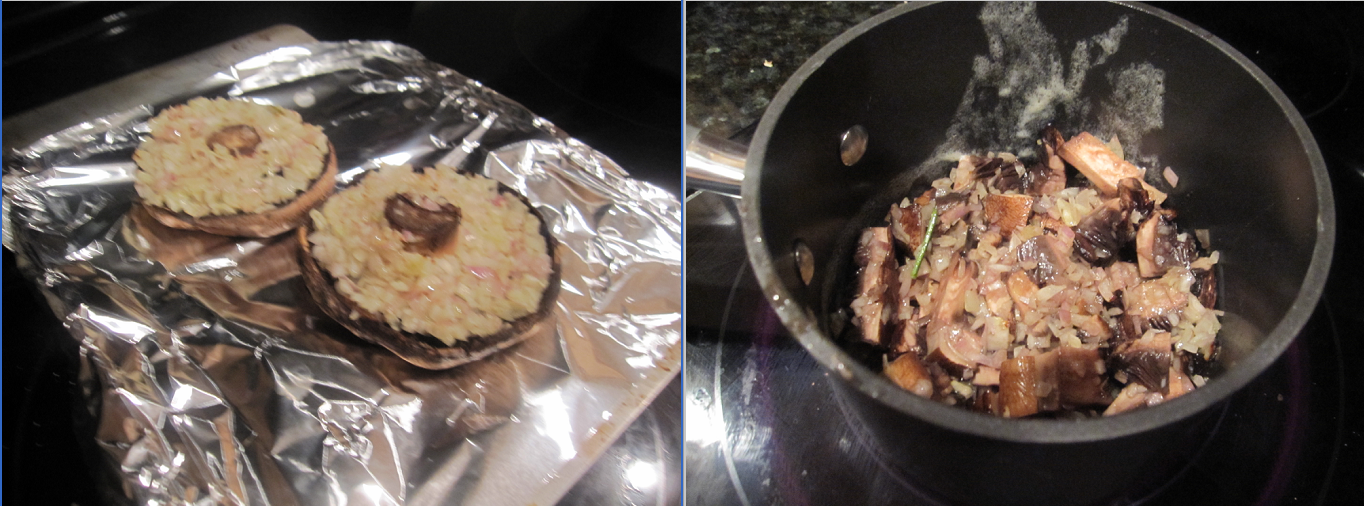
I stemmed the portobellos and placed them gill side up on a baking sheet. I scooped a mixture of minced shallots and olive oil onto the mushroom caps. I roasted the mushrooms for a couple of minutes, just until hot. I then diced the mushrooms and transferred them to a saucepan.

Mushroom caps with shallots

In another small saucepan I melted some butter. I drained the root vegetables and placed them along with the fennel into a large bowl. I tossed it all with the melted butter, olive oil, salt, and pepper. I transferred the veggies to two baking pans, added some water, and roasted the vegetables.

Veggies ready to be roasted

While the vegetables roasted, I removed the pork from the marinade and strained the marinade into the saucepan containing the mushrooms. I added the chicken broth to the saucepan and brought it all to simmer, until slightly thickened.

Mushrooms with Merlot marinade and chicken broth simmering

I patted the pork dry, and rubbed it with salt, pepper, and olive oil. The pork went into the oven to roast until it registered 145 degrees on a thermometer. Once the pork was done, I let it rest for a few minutes.

Pork tenderloin ready to be roasted

While the pork rested, I brought the mushroom mixture back to a simmer and stirred in some butter, salt, and pepper. I also removed the vegetables from the oven.

Roasted veggies and finishing mushroom sauce with butter

Finally, I carved the pork into quarter inch slices and placed it on a platter. I covered it with roasted vegetables and spooned the portobello sauce on top. It was now ready for consumption.

Pork Tenderloin with Portobello Mushroom Sauce

I may have overcooked the pork ever so slightly but it was still very good and moist. The meaty texture of the portobello actually played off nicely with the texture of the tenderloin and it was surprising how well they complimented one another. The roasted root vegetables brought an added dimension to this dish and made the whole thing feel homely and hearty. I also had never roasted fennel prior to this recipe and really enjoyed  the licorice-like flavor. Furthermore the portobello mushroom sauce had tons of flavor...I'm sure the added tablespoons of butter at the end had nothing to do with that at all (just kidding). Overall, great dish and full of flavor.

Enjoy!

Friday, December 9, 2011

Venison Stew with Goat Cheese Johnnycakes

Recipe: Venison Stew with Goat Cheese Johnnycakes
Page: 190
Date Cooked: November 28, 2011

Of all the recipes in "A Great American Cook," this I think is by far the most daunting. I remember flipping through the cook book when I first got it and thinking, "Wow! That is a lot of ingredients for one recipe AND a whole lot of steps." However, I think I am always up for a bit of a challenge.

Unfortunately, my grocer didn't have any venison in stock. But perhaps it was somewhat fortunate, because it goes for $20/lb - which is a bit out of my price range, being a grad student and all. But no fear, JW gives the option of using boneless beef chuck or pork shoulder as a substitute - so pork shoulder it was.

Ingredients: Garlic, pork bones, onions, carrots, olive oil, bouquet garni (not pictured), Kosher salt, pepper, pork shoulder, serrano peppers, leeks, butter, Cabernet Sauvignon, rosemary, thyme, carrots, new potatoes, turnips, parsnips, celery root, bacon, eggs, milk, all-purpose flour, cornmeal, soft goat cheese, and parsley

There are three main components to this stew: the stock, the stew, and the johnnycakes.

The Stock

I put horizontally halved garlic heads (which had been peeled) along with the pork bones, whole onions, and carrots into a roasting pan. I drizzled the ingredients with olive oil and placed the pan in the oven to roast.

Roasting stock components

I transferred the bones and vegetables to a pot and deglazed the roasting pan with some water. I poured the liquid along with some more water into the pot and brought it all to a boil. I then reduced the temperature down to a simmer and added the bouquet garni. The stock simmered for a few hours.

The stock simmering

A quick side note about the bouquet garni. It is simply a herb bundle used to flavor stocks and stews. It includes items such as - bay leaves, parsley sprigs, leek greens, ginger, and black peppercorns. As you can see in the picture above, I used the aforementioned ingredients and tied them up into cheesecloth and put it right in the stock.

Once the stock was ready, I stained it into a bowl, covered it, and allowed it to chill. I then skimmed any fat off the top of the stock (which this had very little) and poured the liquid into a pan and reduced it down. The stock was then seasoned and set aside.

Left: Taking large components out of pot before straining
Right: Strained stock

The Stew

First, I cut the pork shoulder into 2-inch cubes and seasoned with salt and pepper. I roasted the chiles under a broiler until blackened and blistered. I put them into a bowl, covered it with plastic wrap, and allowed the chiles to steam. While the chiles steamed, I quartered onions, peeled garlic cloves, and sliced leeks. Then, I peeled with chiles with my fingers; stemmed, seeded, and thinly sliced them.

1. Pork cubes 2. Quartered onions 3. Peeled garlic cloves 4. Sliced leeks

1. Serrano chiles 2. Chiles, blackened and blistered 3. Steaming chiles 4. Thinly sliced chiles

I added butter and olive oil to a Dutch oven over medium heat and browned the meat in batches. As it browned, I transferred the meat to a plate with a slotted spoon. 

Browning meat in batches

Once all the meat had been browned, I cleaned out the pot, and melted some butter. I added the onions and cooked until soft for a few minutes. I then added the garlic, chiles, and leeks. All items cooked slowly. Finally, I put in the meat back in, poured in the Cabernet, the reduced stock, chopped rosemary, and thyme leaves. I covered the pot and brought the stew to a simmer. The stew simmered for a hours until the meat was really tender. 

Stew simmering for hours

The Johnnycakes

While the stew simmered, I made the batter for the johnnycakes. I beat melted butter and milk into a bowl of eggs. I then whisked in the flour and cornmeal. Finally, I crumbled the goat cheese into the batter. I covered the bowl and put it in the fridge. 

Johnnycake batter

Back to the stew...

Finishing the stew meant including all those root vegetables. I peeled and cut the carrots, potatoes, turnips, parsnips, and celery root. I placed the vegetables into a bowl of cold water and set aside. 

1. Carrots 2. Potatoes 3. Turnips 4. Parsnips 5. Celery root

I also cut the bacon into lardons and fried them in a skillet until golden brown. I removed the bacon with a slotted spoon and drained them on paper towels

Frying up lardons of bacon

Once the meat in the stew was tender, I brought a large pot of water to boil, reduced it to a simmer, and added in all the root vegetables. I cooked the vegetable just until tender. I took heed to JW's warning... "Many people overcook their root vegetables when they make stews. Don't be one of them!"

Cooking root vegetables. I forgot about the carrots initially, but cooked them separately later on.

I then added the root vegetables and bacon to the stew, checked for seasoning, and kept the stew warm.

Finished stew

Back to the johnnycakes...

Finally, I whisked the johnnycake batter and some salt and pepper. I melted butter into a skillet, added some of the batter to the pan and cooked the pancake till golden brown on each side. I transferred them all to a plate and kept warm. 

Cooking the johnnycakes

Ready to eat...

I spooned the stew into bowls, draped a johnnycake over the bowl, and sprinkled it with parsley.

Venison Stew with Goat Cheese Johnnycakes

So if you're actually still with me, I can go ahead with the verdict. It was damn good. Flavors - check. Texture - check. Heartiness - check. Freshness - check. Everything was there. The stew was cooked to perfection. And I think I know what Jonathan Waxman is saying about people overcooking root vegetables. The vegetables were obviously cooked but had that al dente bite to them which worked so well alongside the tender pork shoulder. 

The surprising component of the stew was without a doubt the johnnycakes. They were amazing! The goat cheese played nicely with the cornmeal pancake. I found myself just taking one off of the stack and eating it on its own. It was soo freaking good. 

Overall, lots of ingredients. A good amount of work. But at the end of the day it made enough for several meal and is super easy to freeze. So...yeah...I think it was a good one.

Enjoy!

Sunday, November 13, 2011

Filet Mignon with Pepper-Potato Gratin

Recipe: Filet Mignon with Pepper-Potato Gratin
Page: 172
Date Cooked: November 10, 2011

The ingredient list for this recipe was quite interesting. I needed a variety of peppercorns, oranges, three different bell peppers, and even a poblano chile. Accordingly, it is safe to say that this wasn't going to be a particularly simple tasting steak and potato kind of dish.

Ingredients: Black peppercorns, pink peppercorns, green peppercorns, orange, kosher salt, filet mignon, russet potatoes, red bell pepper, green bell pepper, yellow bell pepper, poblano chile, garlic, milk, black pepper, unsalted butter, heavy cream, cinnamon, and olive oil

I spread the peppercorns on a baking sheet and toasted them in the oven for a few minutes. I want to make a note here that the recipe also calls for white peppercorns, which I didn't have, but compensated for by using a bit additional of the other three (black, pink, and green) peppercorns. The toasted peppercorns were incredibly fragrant. I loved how it smelt throughout my kitchen. And amazingly there was no sneezing. Once they toasted, I coarsely ground the peppercorns using a coffee grinder. Finally, I grated the orange zest and mixed it in with the peppercorns along with some salt to dry on a plate. I also juiced the orange and placed it on a side.

Left: Toasting the peppercorns
Right: Steak spice rub - peppercorns + orange zest + salt

With the spice rub drying, I moved on to the gratin. I peeled the potatoes and placed them in cold water. I then put the bell peppers and poblano chile under the broiler until blackened and blistered all over. I then put the peppers in a bowl, covered it with plastic wrap, and let it steam for a few minutes. Finally, I peeled the peppers and chile using my hands, stemmed, seeded, and cut the peppers in half. This is a technique JW likes to use a lot and by this time I felt like a pro.

1. Peppers + poblano chile
2. Blackened and blistered peppers + poblano chile
3. Peppers + poblano chile steaming
4. Peppers + poblano chiles - peeled, stemmed, seeded, and halved

I buttered and garliced (rubbed a garlic clove inside the dish) a baking dish. I also put the milk and a garlic clove into a small saucepan and let it simmer for a few minutes. I removed the garlic and kept the milk warm. I also drained the potatoes and used my food processor to slice them wafer-thin.

Left: Garlic infused milk
Right: Sliced potatoes

Then it was on to layering the gratin. I put about a third of the potatoes in the dish, seasoned with salt and pepper, added a layer of the poblano chiles, dotted with butter, and poured in a third of the garlic-infused milk. I then added another third of the potatoes, seasoned with salt and pepper, added a layer of the bell peppers, dotted with butter, and poured in a third of the garlic-infused milk. Finally, I added the last of the potatoes, seasoned with salt and pepper, dotted with butter, and poured in the remaining garlic-infused milk.

Making the Pepper-Potato Gratin

I placed the gratin in the oven until the milk had been absorbed by the potatoes. In the meantime, I heated the cream with the cinnamon stick until it was hot. I kept the cream warm and discarded the cinnamon stick. I poured the cream over the gratin and placed it back in the oven.

Left: Cinnamon-infused heavy cream
Right: Poured heavy cream over gratin

The gratin baked until the potatoes were tender and golden brown on top.

Pepper-Potato Gratin

Now to the steaks...You have the option to either grill the steaks or panfry them. Since I don't have a grill, I had to panfry. I heated olive oil in a cast iron skillet and placed it over high heat for a few minutes. In the meantime, I brushed the steaks with olive oil and dipped them in the peppercorn-zest mixture to fully coat. I added the steak to the skillet and reduced the heat to medium-high and cooked for 5 minutes per side (achieving a perfectly rare steak). I removed the steak from the skillet and allowed it to rest.

While the steak rested, I melted some butter in a sauce pan and added the reserved orange juice. The mixture cooked until reduced and thickened.

A few notes here: Since you are trying to achieve that grilled steak taste, the pan gets incredibly hot and there is A LOT of smoke. You have to keep your range hood on. I even had to open the windows, it got pretty bad. Also, JW's cooking times for getting that perfect rare steak was exactly right! I am not really a pro when it come to cooking steak and am always iffy about the timing - but not anymore!

Panfrying the filet mignon
1. Peppercorn-zest crusted filet mignon
2. Pan frying one side
3. Flipped to the other side

Finally, it was time to plate. I put the steak on a plate and topped it with the orange-butter sauce. I also placed the pepper-potato gratin alongside the steak.

Filet Mignon with Pepper-Potato Gratin

This dish was super yummy and incredibly hearty. And the flavors worked wonderfully. You would think the orange-butter sauce would make the filet mignon sweet - but it didn't. It gave it a really beautiful fresh tasting flavor and it balanced the peppercorn so well. And the gratin was really creamy and I loved the use of the peppers and poblano chile. It gave the dish a nice spicy note, which also played off the orange flavor nicely.

I think this recipe is a perfect example of taking something like meat and potatoes and adding a few other ingredients to really transform a dish. Next time I want to treat myself to filet mignon - this may be the route I take.

Enjoy!

Sunday, August 28, 2011

Brined Pork Loin with Huckleberries or Blueberries

Recipe: Brined Pork Loin with Huckleberries or Blueberries
Page: 175
Date Cooked: August 19, 2011

The key word for this recipe was: brining. I personally was interested in what exactly brining did to the meat.  You hear about it many times, but what is the true difference between a brine and a marinade. Sorry the nerd in me is going to rant for the next few sentences. From what I gather a brine is simply salt water. Allowing meat to sit in a brine allows it to become more tender when cooked because the meat cells have absorbed a lot of water from the brine solution via osmosis. Furthermore, the salt in the brine denatures the meat proteins further preventing dehydration when cooked. All in all you end up with a tender and moist piece of meat.

Ingredients: Pork loin (not shown), salt, sugar, carrots, onions, garlic, shallots, ginger, leeks, celery, butter, bay leaves, Beaujolais Nouveau, small potatoes, pepper, blueberries, and red wine vinegar

The pork was placed in a brine overnight. To create the brine, I dissolved salt and sugar in boiling water. I put the pork in a dish and covered it with the brine, turning it a few times during the overnight process.

Pork loin in brine
The next day, I proceeded to prepare all the ingredients. I peeled the carrots, onions, garlic, shallots, and ginger; and cleaned the leeks. I cut the carrots, leeks, and celery into lengths and quartered the onions. During this time, I also removed the pork from the brine and placed it into a Dutch oven with butter and browned it on all sides.

Left: Veggie mise en place Right: Browning pork

After I removed the pork from the pan, I added the carrots, onions, shallots, ginger, and garlic and browned them all on sides. I then added the leeks, celery, bay leaves, pork, wine, and enough water to completely cover the meat. The contents were brought to a boil, the pan was covered and placed in the oven.

1. Browning carrots, onions, shallots, ginger, and garlic 2. Added the leeks, celery, and bay leaves
3. With the pork, wine, and water

After the meat was "fork tender," I removed the casserole from the oven and took out the pork and covered it on a plate. I then let the cooking liquid reduce down to a few cups. I emptied the contents of the pan, strained the liquid, and then placed it back into the pot along with the pork.

Pork with reduced braising liquid

While the braising liquid reduced I worked on the potatoes. I set them into a saucepan with some water and salt and brought it a boil. I drained the potatoes, placed them back in the saucepan, and mashed them. I added some butter, salt, and pepper and kept the potatoes warm.

Mashed potatoes

Finally, it was time to create the blueberry sauce. I put some blueberries and red wine vinegar into a pan and brought it to a boil until it thickened. I then added the reduced braising liquid along with the rest of the blueberries and allowed it to simmer for a bit.

Blueberry sauce

While the blueberry sauce simmered, I sliced the pork into thin slices and situated them onto the plate. Finally, I poured the berry sauce onto the pork and served it with the potatoes.

Brined Pork Loin with Blueberries

A big reason I selected this cookbook was because I don't really cook "American" food (at least in the way I define it). This meal felt very "American" to me. It was a traditional meal and was quite homey (maybe it was the mashed potatoes that did it). I enjoyed the dish very much. There is no doubt to me that the brining and braising amplified the pork's "flavor and richness." It was perfectly tender and I really loved the acidity and sweetness of the sauce. It made for a beautiful plate. The potatoes were a side, nothing too exciting there. But it made sense, the star on the plate was the pork and the sauce.

Enjoy!